Table Of Content
With an 80% gross margin, they would need a 17% market share to break even. I see that as impossible because getting this market share will require a lot of time, and it would be impossible to think that Cadence and Synopsys wouldn’t react. The other segment (42%) is niche market segments that are less profitable, and to capture a significant part of this market, you would need to have an even more complex product. This tutorial will be of particular interest to instructors who have students do a major project as part of their course.
Entity Relationship Model
Each use case is a business scenario or event for which the system must provide a defined response. As I have shown, I describe Cadence's business model as solid; my base-case scenario is my conservative and lower-case scenario. The first one is Synopsis gaining market share thanks to its good positioning in the growing hyper-convergence between the electrical, mechanical, and physical domains, thanks to the acquisition of Ansys. Cadence and Synopsys are working with the biggest and most profitable clients. In that case, it must invest at least the same level of research and development expenses, even though it would have to expense much more to gain the 30-year experience Cadence and Synopsys have. The same occurs with sales and marketing expenses and general and administrative expenses.
Spiral Model[edit edit source]
What is the Waterfall Model? - Definition and Guide - TechTarget
What is the Waterfall Model? - Definition and Guide.
Posted: Mon, 14 Mar 2022 20:56:56 GMT [source]
Analysis can also be a series of components that perform organic functions together, such as systems engineering. Systems engineering is an interdisciplinary field of engineering that focuses on how complex engineering projects should be designed and managed. This information will become the projects charter and the basis for initiating the project. The project then follows the PLAN-DO CHECK-ACT cycle (as defined by Shewhart and modified by Deming, in the ASQ Handbook, pages 13-14, American Society for Quality, 1999).
Information Security in the Systems Development Life Cycle[edit edit source]
System analysis and design are fundamental processes that help us navigate the complexities of modern systems and to make innovation in a rapidly changing world. Chapter 3 helps students evaluate software by assessing trade-offs among creating custom software, purchasing commercial-off-the-shelf (COTS) software, or outsourcing to an application service provider (ASP). Creating a problem definition and determining feasibility are also covered.
As opposed to legitimately portraying the general conduct of the system, the simulation model depicts the activity of the system as far as individual occasions of the individual segments of the system. Now, here we will catch a glimpse of some tools and techniques of system analysis. Accordingly, system analysis is unique to system officials, who keep up systems every day, and their roles normally include a high-level perspective on a system to decide its general viability as per its plan.
Chapters
It covers the life of the system from planning, through launch, to assessment. A key concept in information technology, the SDLC encompasses a mix of software and hardware configurations. These can include systems consisting of only software, only hardware, or a combination of both. In software development, system design is the process of defining the architecture, interfaces, and data model for a system to satisfy the requirements outlined in the SRSs.
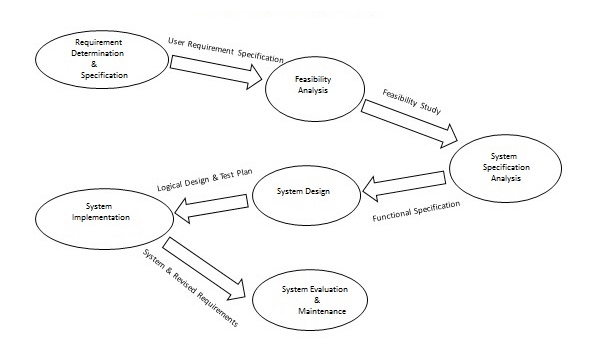
Systems modification is an organized procedure that involves phrases like planning, analysis, design, deployment, and maintenance. System analysis ensures that a product is made properly and delivered timely. This may seem to be a small detail, but it plays a vital role in the field of business. When the system of making a product is analyzed properly, it will greatly reduce the scope for errors. Thus, employers can teach system analysis to employees by using diagrams, which makes it less time consuming and also cost-efficient. The simulation includes the development of a model that is generally numerical.
Planning[edit edit source]
Although this section presents the information security components in a sequential top-down manner, the order of completion is not necessarily fixed. Security analysis of complex systems will need to be iterated until consistency and completeness is achieved. A system is a set of things that work together as an interconnecting network to achieve a particular goal. Systems are everywhere around us such as computer systems which have both hardware and software to execute certain functions. It is the arrangement of components that helps to achieve predetermined objectives.
Structured / Waterfall[edit edit source]
Structured analysis is a traditional systems development technique that is time-tested and easy to understand. Because it describes the processes that transform data into useful information, structured analysis is called a process-centered technique. In addition to modeling the processes, structured analysis includes data organization and structure, relational database design, and user interface issues.
I have analyzed Cadence's business model in the article, confirming my expectations about its competitive advantages. I have confirmed that the industry is very attractive, dominated by Cadence and Synopsis, with high returns and barriers to entry. Likewise, I have compared Cadence and Synopsis, stating the advantages of the first over the second. Profitability in Cadence is higher than Synopsys in all indicators, as shown in Figure 5. Returning to the primary measure of value, the leveraged FCF margin is 22.7% vs 18.4%.
So, even though both companies are very similar, Cadence has a light competitive advantage over Synopsys due to its margin management. The Department of Computer and Information Technology provides educational opportunities that apply information technology to solve societal challenges. From cyber forensics and Big Data, to databases and analytics, impactful research is improving society and enriching the constantly updated academic programs.
Process modeling identifies the data flowing into a process, the business rules that transform the data, and the resulting output data flow. Chapter 2 includes how to initially approach an organization by drawing context-level data flow diagrams, using entity-relationship models, and developing use cases and use case scenarios. Chapter 3 introduces expanded material on creating the project charter and introduces writing the systems proposal early in the process, no matter what method of analysis and design has been chosen. Expanded coverage of evaluating software and hardware, and when to use COTS (commercial off-the-shelf software), is included.
PCMag.com is a leading authority on technology, delivering lab-based, independent reviews of the latest products and services. Our expert industry analysis and practical solutions help you make better buying decisions and get more from technology. Now, let's move towards another interesting part that is System Analysis and Design or SAD.


No comments:
Post a Comment